No Ordinary Cave…
Far beneath the familiar forests, oceans, villages, and caves of Minecraft lies one of the most dangerous places in the Overworld: the Deep Dark.
This underground biome is unlike an ordinary cave. Monsters normally do not spawn here. Instead, the ground is covered with strange sculk, sound itself becomes a threat, and careless explorers can awaken the Warden—a creature deliberately designed to be avoided rather than fought.
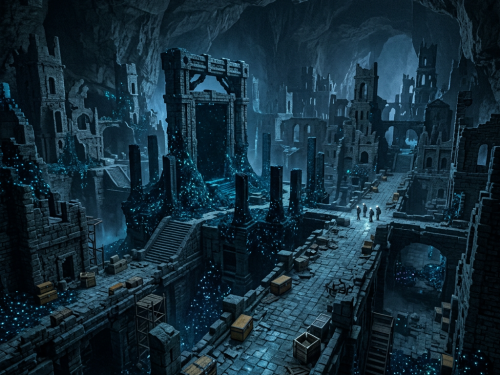
Hidden within some Deep Dark biomes are enormous ruined settlements called Ancient Cities, containing treasures that cannot be found anywhere else.
This guide covers the Deep Dark, Ancient Cities, the sculk family, Wardens, Ancient City loot, and strategies for surviving an expedition into the depths.
When Were the Deep Dark and Ancient Cities Added?
The Deep Dark, Ancient Cities, sculk blocks, and the Warden were officially added to Minecraft in Java Edition 1.19: The Wild Update, released on June 7, 2022.
The update introduced an unusual style of Minecraft exploration. Instead of defeating enemies to secure an area, players are encouraged to use stealth, distraction, wool, and careful movement.
The Warden is consequently not considered a conventional boss like the Wither or Ender Dragon. The challenge is surviving it—or preventing it from appearing at all.
What Is the Deep Dark?
The Deep Dark is an underground Overworld biome found in the lowest portions of the world.
It generates deep beneath the surface among the deepslate layers and is especially associated with areas beneath mountainous terrain and other regions with low erosion. Searching underneath mountain biomes such as Jagged Peaks or Snowy Slopes can therefore be an effective way of finding one.
Deep Dark terrain is immediately recognizable by patches of dark blue-green sculk spreading across the stone.
Another unusual feature is the absence of normal mob spawning.
Zombies, skeletons, creepers, spiders, and most other ordinary hostile mobs do not naturally spawn in the Deep Dark.
That does not make it safe.
The biome has something considerably worse.
The Sculk Family
Sculk is more than decoration. Several related blocks form a vibration-detection system capable of responding to activity around them.
The major sculk blocks are:
Sculk
The basic dark blue-green block covering much of the Deep Dark.
Sculk Vein
Thin sculk growth that spreads across the surfaces of other blocks.
Sculk Sensor
Detects nearby vibrations.
Sculk Shrieker
Produces a terrifying shriek and, under the right circumstances, can contribute toward summoning a Warden.
Sculk Catalyst
Causes sculk to spread when nearby mobs die and would normally drop experience.
The preferred tool for quickly breaking sculk blocks is generally a hoe.
Silk Touch is important if you want to collect many sculk blocks themselves rather than simply destroying them for experience.
Sculk Sensors: The Deep Dark Is Listening
A sculk sensor detects vibrations.
Many ordinary actions can create vibrations, including:
- Walking or running
- Jumping
- Landing
- Breaking blocks
- Placing blocks
- Opening containers
- Firing or landing projectiles
- Dropping or moving certain objects
When a sensor detects a vibration, it activates and can transmit a redstone signal.
That makes sculk sensors useful outside the Deep Dark as components for wireless redstone systems.
Inside an Ancient City, however, their importance is much more immediate.
A sensor can transmit a vibration to a nearby sculk shrieker.
And that is where the trouble begins.
Wool: The Ancient City Explorer’s Best Friend
Wool has a special relationship with vibrations.
Wool blocks can block vibrations from traveling between a vibration source and a sculk sensor.
Wool can also be used to isolate sensors and shriekers from one another.
This makes a stack—or several stacks—of wool one of the most valuable things you can bring into an Ancient City.
Wool carpets are also useful for creating quiet paths across dangerous areas.
Do not assume that simply crouching makes absolutely everything safe. Sneaking prevents many movement-related vibrations, but other actions can still produce vibrations.
Sculk Shriekers
The most dangerous sculk block is the sculk shrieker.
When activated, a shrieker produces its distinctive scream and inflicts the Darkness effect on nearby players.
More importantly, naturally generated shriekers can eventually summon a Warden.
The Warning System
A Warden does not normally appear after your first mistake.
Shrieker activations increase a player’s warning level. Repeated warnings eventually cause a Warden to emerge from the ground nearby.
In practical terms:
Four qualifying warnings can summon a Warden.
The warning system is associated with the player, so simply moving to another shrieker does not necessarily give you a clean slate.
Warnings can gradually decrease if enough time passes without further triggering the system.
This means the safest response to repeated shrieks is often to stop exploring and allow the situation to calm down.
Not Every Shrieker Can Summon a Warden
There is an extremely important distinction between naturally generated shriekers and player-placed ones.
A naturally generated sculk shrieker capable of summoning Wardens has special world-generation data associated with it.
If you collect a shrieker and place it somewhere else, the placed shrieker can still activate and make noise, but it cannot summon a Warden.
Shriekers created through sculk spreading likewise should not be treated as a portable Warden-summoning system.
So no—you cannot normally take a shrieker home, place it underneath your friend’s house, and turn their basement into an involuntary Warden habitat.
Sculk Catalysts
The sculk catalyst explains how sculk can spread.
When a mob dies near a catalyst, experience that would normally be dropped by that mob can instead become a sculk charge.
That charge travels through nearby blocks and converts suitable terrain into sculk.
The amount of sculk that can spread is related to the amount of experience the creature would have dropped.
Under appropriate circumstances the spreading process can also generate sculk veins, sensors, and shriekers.
This mechanic allows players to deliberately create sculk farms and convert mob experience into sculk growth.
Ancient Cities
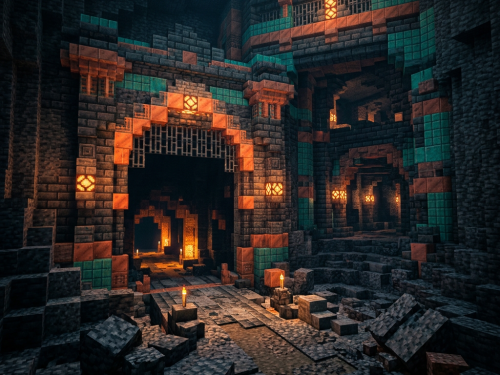
Ancient Cities are enormous ruined structures that generate within the Deep Dark.
They are among the largest generated structures in Minecraft and consist of sprawling corridors, walls, towers, chambers, ruined buildings, and a massive central structure.
Not every Deep Dark biome contains an Ancient City.
Finding sculk therefore means you have found the correct biome, but it does not guarantee that a city is nearby.
Ancient Cities tend to be found beneath mountainous regions, making mountain ranges useful places to begin searching.
The City Center
One of the easiest landmarks to recognize is the enormous structure near the center of an Ancient City.
It contains a huge frame-like construction made partly from reinforced deepslate.
The shape has generated considerable speculation among Minecraft players because it resembles a giant portal.
At present, however, it does not function as a usable portal in normal Survival gameplay.
Reinforced deepslate is also unusual because players cannot obtain it normally in Survival.
There is currently no legitimate Survival recipe for picking up the blocks and rebuilding the structure somewhere else.
Ancient City Loot
Why risk entering an Ancient City?
Because several valuable items are either exclusive to Ancient Cities or particularly desirable there.
Among the important treasures are:
Echo Shards
Echo Shards are found in Ancient City chests.
Eight Echo Shards can be combined with a compass to make a:
Recovery Compass
The Recovery Compass points toward the location of your most recent death.
There are two important limitations.
It only works while you are in the same dimension in which you died, and if you have no valid death location it simply spins.
Disc Fragment 5
Ancient City chests can contain Disc Fragment 5.
Collect nine fragments and arrange them in a crafting table to create:
Music Disc 5
Unlike most Minecraft music discs, Disc 5 must therefore be assembled rather than found intact.
Swift Sneak
Ancient Cities are the source of the Swift Sneak enchantment.
Swift Sneak increases your movement speed while crouching, making it especially appropriate for the place where it is discovered.
It has three levels:
Swift Sneak I
Swift Sneak II
Swift Sneak III
Higher levels allow considerably faster movement while sneaking.
Swift Sneak is applied to leggings.
Because Ancient City exploration heavily rewards crouching, obtaining Swift Sneak can make later expeditions much easier.
Armor Trims
Ancient Cities can also provide exclusive smithing templates associated with the structure, including:
Ward Armor Trim
and the much rarer:
Silence Armor Trim
These templates allow players to add distinctive cosmetic trim patterns to armor.
Remember that smithing templates are consumed when used. If you want additional copies, duplicate a valuable template before spending your last one.
Other Treasure
Ancient City chests can contain a variety of other useful items, including enchanted equipment and books, diamonds and diamond equipment, enchanted golden apples, experience bottles, name tags, saddles, leads, candles, sculk-related items, and other supplies.
Different structures or rooms within the city can also contain specialized loot.
Because the city is enormous, thoroughly searching one Ancient City can yield a substantial haul.
The problem is surviving long enough to carry it home.
The Warden
The Warden is the creature that makes the Deep Dark genuinely dangerous.
It does not patrol Ancient Cities waiting for players.
Instead, Wardens normally remain underground until summoned through repeated sculk-shrieker warnings.
When one is summoned, it literally emerges from the ground.
At that point, the expedition changes considerably.
The Warden is Blind
Wardens cannot see.
Unfortunately, that does not make them easy to evade.
A Warden detects its surroundings using vibrations and can also sniff to locate nearby creatures.
Making repeated vibrations increases its anger toward the source.
Once sufficiently angry, the Warden roars and begins actively pursuing its target.
Being invisible does not solve the problem. Neither does simply hiding behind a wall.
The Warden’s Sonic Boom
Players quickly discovered that an extremely powerful melee mob could seemingly be defeated by building upward or hiding behind blocks.
The Warden has an answer to that.
Sonic Boom.
When its target cannot easily be reached, the Warden can unleash a ranged sonic attack.
The attack can pass through blocks.
That means several classic Minecraft survival tricks are unreliable:
Building a small tower does not necessarily save you.
Hiding behind a wall does not necessarily save you.
Digging yourself into a tiny enclosure does not necessarily save you.
The Warden was specifically designed to make ordinary cheesing strategies much less effective.
How Strong is a Warden?
Very.
A Warden has:
500 health points — 250 hearts.
For comparison:
Ender Dragon: 200 health / 100 hearts
Wither: 300 health / 150 hearts in Java Edition
The Warden therefore has considerably more raw health than either of Minecraft’s traditional bosses.
Its melee attacks are devastating, its sonic attack gives it ranged capability, it is highly resistant to attempts to control it, and it is immune to fire and lava damage.
This is intentional.
Should You Kill the Warden?
Usually, no.
The Warden is not intended to be a conventional boss encounter.
Killing one does not reward you with some legendary weapon or unique armor set.
A defeated Warden drops a sculk catalyst and a small amount of experience.
Considering the enormous danger involved, that is deliberately poor compensation.
The real rewards of the Deep Dark are located in the Ancient City, not inside the Warden.
The intended challenge is getting the treasure without fighting it.
What to Bring to an Ancient City
Preparation matters more here than almost anywhere else in the Overworld.
Recommended equipment includes:
Wool — Probably your most important specialized supply. Use it to block vibrations and isolate dangerous sculk components.
Wool Carpet — Useful for creating quiet routes.
A Hoe — Sculk blocks are most efficiently broken with hoes.
Silk Touch — Bring it if you intend to collect sculk sensors or other sculk blocks.
Food — You may spend a long time underground.
Torches — Ancient Cities are extremely dark, although remember that placing blocks can itself create vibrations.
Ender Pearls — Potentially useful for emergency movement, although their use can also create vibrations.
Snowballs or other projectiles — Useful for deliberately creating vibrations away from your position and distracting a Warden.
Night Vision Potions — Extremely useful for seeing the city’s layout.
Fire Resistance — Useful for ordinary underground hazards, but remember that lava is not an effective solution to a Warden.
Good armor — Useful if something goes wrong, although armor should never make you feel invincible around a Warden.
An Escape Route — Know how you intend to leave before things go badly.
How to Raid an Ancient City
The safest Ancient City explorer is a patient one.
1. Stop Running
Once you enter sculk-covered territory, begin treating movement as a potential hazard.
Crouch.
Ancient Cities reward slow exploration.
2. Watch for Sensors and Shriekers
Before opening a chest or breaking blocks, inspect the surrounding area.
A nearby sensor may hear what you are about to do.
More importantly, determine whether that sensor can communicate with a shrieker.
3. Use Wool
Place wool strategically between sensors and potential vibration sources.
Wool can also isolate dangerous sculk blocks while you work around them.
4. Loot Carefully
Opening containers can produce vibrations.
Do not simply sprint from chest to chest.
Study the sculk network surrounding each treasure location first.
5. Count Your Warnings
One shriek is a warning.
Several are a serious problem.
If you have triggered multiple shriekers, consider retreating and waiting rather than continuing to push your luck.
6. If a Warden Appears, Stop Treating the City Like a Dungeon
Do not charge it.
Do not assume your armor will carry you through the fight.
Create distance quietly.
Projectiles such as snowballs can create vibrations elsewhere and potentially draw its attention away from you.
7. Let the Warden Leave
A Warden that cannot detect anything and does not remain angry indefinitely will eventually dig back into the ground.
Sometimes the correct move is simply to hide at a safe distance, remain quiet, and wait.
Distracting a Warden
Because Wardens investigate vibrations, you can deliberately create noises away from yourself.
A thrown snowball, for example, can create a vibration where it lands.
The Warden may investigate that location.
This gives you an important survival tool:
Sound can betray you, but sound can also be used as bait.
Do not repeatedly bombard a Warden without understanding what you are doing. Repeated projectile activity can increase its anger toward the attacker rather than endlessly fooling it.
Use distractions to escape—not to torment something with 250 hearts.
The Darkness Effect
Sculk shriekers and Wardens can inflict Darkness.
Darkness periodically reduces the player’s ability to see, creating a pulsing effect in which the surrounding environment becomes extremely difficult to make out.
This is one reason Ancient City encounters can become disorienting so quickly.
Minecraft includes an accessibility setting that allows players to adjust the intensity of the Darkness visual effect.
Changing that setting can make the visual effect less severe, but it does not simply remove every danger associated with the Warden or Deep Dark.
Can You Make a Sculk Farm?
Yes.
A sculk catalyst can convert the experience value of nearby mob deaths into spreading sculk.
Players can therefore combine catalysts with mob farms to produce large quantities of sculk.
Sculk itself can also be useful as a source of stored experience because breaking appropriate sculk blocks without Silk Touch releases XP.
Sensors additionally have extensive redstone applications because they allow machines to react to vibrations without a physical redstone connection.
The Deep Dark therefore introduced an entire branch of Minecraft technology in addition to its exploration content.
Ancient City Survival Tips
Remember these rules when exploring:
Crouch instead of running.
Bring wool. Lots of wool.
Watch for shriekers before opening chests.
Do not assume darkness means ordinary monsters are nearby—the Deep Dark normally prevents natural mob spawning.
Do not panic after one shriek, but take every shriek seriously.
Use sound strategically to distract a Warden.
Do not rely on walls or towers to protect you from Sonic Boom.
Remember that the Warden is blind, not helpless.
Know your escape route.
If a Warden appears, survival is more important than finishing the room you were looting.
And above all:
You do not have to kill the Warden.
Minecraft deliberately turns the usual progression of exploration on its head in the Deep Dark. The strongest player is not necessarily the one carrying the strongest sword.
It is the one who knows when not to use it.
Quick Reference
Deep Dark introduced: Java Edition 1.19 — The Wild Update
Ancient Cities introduced: Java Edition 1.19
Warden introduced: Java Edition 1.19
Normal mob spawning in the Deep Dark: No
Ancient Cities found in: Deep Dark biomes
Best terrain to search beneath: Mountainous regions
Warden health: 500 HP / 250 hearts
Warden vision: Blind
Primary detection: Vibrations, proximity, and smell
Warden ranged attack: Sonic Boom
Can Sonic Boom pass through blocks? Yes
Does a player-placed shrieker summon Wardens? No
Important Ancient City enchantment: Swift Sneak
Important Ancient City resources: Echo Shards and Disc Fragment 5
Exclusive armor trims: Ward and Silence
Recovery Compass recipe: Compass + 8 Echo Shards
Music Disc 5 recipe: 9 Disc Fragment 5
Best specialized Ancient City supply: Wool
Best strategy against the Warden: Avoid it
Need Help?
Most of the information in this guide is applicable to
vanilla Minecraft – Java 26.1.2.
However, this guide was made specifically for
Blockhead Odyssey SMP – mc.BlockheadOdyssey.com
For more assistance, join us on Discord or explore our other guides!
Good next pages: