Version Note: This guide covers Minecraft: Java Edition 26.1.2, the version currently used by Blockhead Odyssey. Vanilla mechanics described here are specific to Java Edition where Java and Bedrock differ.
Forged by Fire
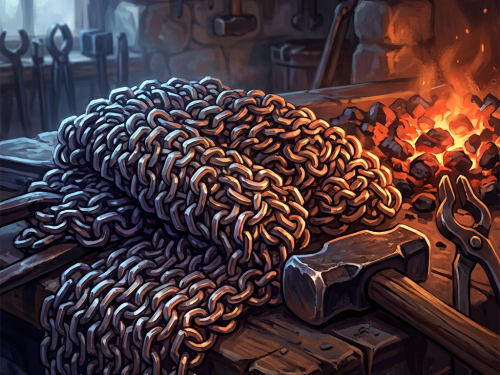
Chainmail armor is one of Minecraft’s oldest and strangest equipment sets. It has been in the game since the early days of Minecraft, yet unlike leather, iron, gold, diamond, and newer armor materials, vanilla chainmail cannot be crafted in modern Minecraft.
That unusual history has turned chainmail into something halfway between ordinary armor and a collectible. It is renewable and obtainable in Survival, but players must acquire it through trading or mob drops rather than simply gathering materials and visiting a crafting table.
On Blockhead Odyssey, chainmail has an additional purpose: it serves as the beginning of a custom mithril armor progression, allowing vanilla chainmail to be upgraded into Mithril Chainmail and eventually into Mithril Plate.
This guide covers chainmail as it works in Minecraft: Java Edition 26.1.2, the version used by Blockhead Odyssey. Minecraft 26.1.2 is a Java Edition hotfix release in Mojang’s current version-numbering system.
What Is Chainmail Armor?
A complete chainmail set consists of four pieces:
- Chainmail Helmet
- Chainmail Chestplate
- Chainmail Leggings
- Chainmail Boots
Visually, the armor represents interlocking metal rings rather than solid plates. It occupies a defensive tier between leather/gold and iron.
A complete vanilla chainmail set provides 12 armor points, represented by six full armor icons on the player’s armor bar. By comparison, a complete iron set supplies 15 armor points.
Chainmail Armor Stats
Chainmail’s individual armor values are:
| Piece | Armor Points | Durability |
|---|---|---|
| Chainmail Helmet | 2 | 165 |
| Chainmail Chestplate | 5 | 240 |
| Chainmail Leggings | 4 | 225 |
| Chainmail Boots | 1 | 195 |
| Complete Set | 12 | — |
Chainmail has exactly the same durability as iron armor, even though it provides less protection.
That is one of chainmail’s more interesting characteristics. An iron chestplate and chainmail chestplate both have 240 durability, for example, but the iron chestplate supplies 6 armor points while chainmail supplies 5.
Chainmail also has an enchantability value of 12, compared with iron’s 9. That gives chainmail somewhat better enchanting potential than iron.
How Much Protection Does a Full Set Provide?
A full chainmail set provides 12 armor points.
Under Minecraft’s modern armor calculations, protection varies somewhat according to how powerful an incoming attack is. Against weaker attacks, the complete unenchanted chainmail set can reduce damage by as much as approximately 48%.
Iron provides 15 armor points, while diamond and netherite provide 20.
That puts the basic progression roughly at:
| Armor | Full-Set Armor Points |
|---|---|
| Leather | 7 |
| Gold | 11 |
| Chainmail | 12 |
| Iron | 15 |
| Diamond | 20 |
| Netherite | 20 |
Chainmail is therefore slightly stronger defensively than gold but noticeably weaker than iron.
The Strange History of Chainmail
Chainmail dates all the way back to Minecraft Indev. Its item textures existed by the very early development period, long before the modern Survival game took its present form.
Its original crafting recipe was one of the strangest recipes Minecraft has ever contained.
Chainmail Was Crafted from Fire
Early Minecraft contained an actual fire item corresponding to the fire block.
Chainmail armor used the ordinary armor crafting patterns—but instead of leather, iron, gold, or diamonds, the crafting slots were filled with fire.
Yes, fire.
The recipes existed from Indev until snapshot 14w25a, during development of Minecraft 1.8. When Mojang eliminated fire’s item form, the chainmail crafting recipes disappeared with it.
This is why longtime players sometimes remember hearing that chainmail was “crafted with fire.” It was not merely a myth or a modded recipe—it really was how Minecraft defined the armor.
For much of that period, however, obtaining fire legitimately was either impossible or limited to unusual versions and circumstances. Chainmail therefore spent much of its early history as an armor set that existed in the game but could not normally be crafted by an ordinary Survival player.
When Did Chainmail Become Normally Obtainable?
Chainmail became normally obtainable in Survival through villager trading in snapshot 12w21a, during development of Minecraft 1.3.
Then, beginning with snapshot 12w32a during development of 1.4, hostile mobs could spawn wearing chainmail armor as well.
Those two systems remain the important ways of obtaining chainmail in Java Edition today.
Can You Craft Chainmail with Chains?
No.
This is probably the most common modern misconception about chainmail.
Minecraft now contains a craftable item literally called a Chain, but vanilla Minecraft still does not provide recipes for chainmail armor using Chains.
Making a helmet-shaped pattern out of Chains does nothing.
Many mods and datapacks add such a recipe because it seems intuitive, but it is not part of vanilla Java Edition 26.1.2. The historical vanilla recipe used the old fire item, not modern Chains.
Getting Chainmail from Armorer Villagers
The most dependable renewable source of chainmail is an Armorer villager.
Armorers sell iron, chainmail, and eventually diamond armor as they advance through their profession levels. Chainmail trades appear among the Armorer’s intermediate trades.
Because villagers can restock their trades, this makes chainmail completely renewable.
If you are trying to assemble several full sets—or need chainmail for progression on Blockhead Odyssey—an established Armorer trading setup is generally much more reliable than hunting armored monsters.
Hero of the Village
Armorer villagers can also give chainmail armor to players as gifts while the player has Hero of the Village, the effect earned after successfully defending a village from a raid. This behavior has existed since the Village & Pillage era.
Getting Chainmail from Zombies and Skeletons
Zombies and skeletons can naturally spawn wearing armor, including chainmail.
If you kill one of these mobs, there is a chance that its equipped armor will drop. An equipped armor piece has a base 8.5% chance of dropping, increased by Looting:
- No Looting: 8.5%
- Looting I: 9.5%
- Looting II: 10.5%
- Looting III: 11.5%
Dropped mob armor is usually badly damaged and may occasionally be enchanted.
This makes mob hunting a valid way to obtain chainmail, although it is much less predictable than villager trading.
Difficulty Matters
Armored zombies and skeletons are more likely under circumstances where mobs spawn with better equipment, particularly as local difficulty increases.
That means players who spend a great deal of time in one region may encounter equipped hostile mobs more frequently than someone moving constantly through freshly generated areas.
What About Buried Treasure?
You may encounter guides claiming that buried treasure is a good source of chainmail armor.
That information is generally referring to Bedrock Edition.
Bedrock buried treasure loot includes chainmail armor pieces, but the equivalent entries are not part of the Java Edition buried-treasure loot table. Minecraft’s loot documentation specifically identifies those chainmail treasure entries as Bedrock Edition items.
For Java Edition 26.1.2, rely on Armorers and equipped mobs instead.
Repairing Chainmail Armor
Even though chainmail cannot be crafted from iron, iron ingots are its repair material.
A damaged chainmail piece can be combined with iron ingots in an anvil to restore durability. Each repair-material unit restores a portion of the item’s maximum durability.
You can also repair matching chainmail pieces by combining them.
Of course, Mending and Unbreaking work normally on chainmail as well.
Enchanting Chainmail
Chainmail accepts the normal armor enchantments appropriate to each slot.
Depending on the piece, these include familiar enchantments such as:
- Protection
- Fire Protection
- Blast Protection
- Projectile Protection
- Unbreaking
- Mending
- Thorns
- Respiration
- Aqua Affinity
- Feather Falling
- Depth Strider
- Frost Walker
- Swift Sneak
- Soul Speed
The exact available enchantments depend on which armor piece is being enchanted.
Because chainmail’s enchantability is 12, it actually has somewhat better enchanting characteristics than iron armor, whose enchantability is 9.
Armor Trims and Chainmail
Chainmail can also participate in Minecraft’s armor trim system.
A chainmail helmet, chestplate, leggings, or pair of boots can be cosmetically decorated at a smithing table using an armor trim smithing template and an appropriate trim material.
Armor trims do not improve the armor’s statistics. They are cosmetic, allowing chainmail to remain visually distinctive even when two players are wearing otherwise identical equipment.
Smelting Chainmail
Chainmail armor can be smelted in a furnace or blast furnace.
Like iron armor, smelting a piece of chainmail produces an Iron Nugget. This ability was added alongside nugget recycling for iron and gold equipment.
That is rarely the most valuable use for an intact chainmail piece, but it gives badly damaged unwanted pieces at least a small recycling value.
Is Chainmail Better Than Iron?
In ordinary vanilla combat, no.
Chainmail and iron have identical durability, but iron provides more armor:
| Piece | Chainmail | Iron |
|---|---|---|
| Helmet | 2 | 2 |
| Chestplate | 5 | 6 |
| Leggings | 4 | 5 |
| Boots | 1 | 2 |
| Full Set | 12 | 15 |
Chainmail does have the higher enchantability value, but that generally does not compensate for losing three armor points across a complete set.
In standard vanilla Minecraft, players usually move directly from leather or assorted early-game armor into iron, leaving chainmail as an interesting find rather than a necessary progression tier.
Why Collect Chainmail?
Even in vanilla Minecraft, chainmail has several reasons to exist beyond its raw defensive value.
It is:
- One of Minecraft’s oldest surviving armor types
- Historically tied to the removed fire-item mechanic
- Uncraftable in ordinary Survival
- Renewable through villagers and mobs
- Fully enchantable
- Repairable with iron
- Compatible with armor trims
- Visually distinct from solid-metal armor
- A recognizable piece of Minecraft history
For collectors, a complete enchanted and trimmed chainmail set makes a particularly appropriate museum or display item.
Chainmail on Blockhead Odyssey
Chainmail has a much larger role on Blockhead Odyssey than it does in ordinary vanilla Minecraft.
Rather than allowing this historic armor set to become obsolete the moment a player acquires iron, Blockhead Odyssey incorporates vanilla chainmail into its expanded armor system.
The progression is:
Vanilla Chainmail → Mithril Chainmail → Mithril Plate
Mithril Chainmail
A vanilla chainmail set provides the foundation for upgrading into Mithril Chainmail.
This gives players a reason to seek out chainmail pieces rather than simply regarding them as inferior iron armor or smelting them for nuggets.
Mithril Chainmail preserves the visual and thematic character of mail armor while transforming it into a much more significant piece of Blockhead Odyssey’s equipment progression.
Mithril Plate
Mithril Chainmail is not necessarily the end of the road.
Players can continue the progression into Mithril Plate, turning an armor set that began as ordinary vanilla chainmail into substantially more advanced equipment.
The complete Blockhead Odyssey progression therefore creates a connection between one of Minecraft’s oldest armor sets and one of Odyssia’s custom materials:
Chainmail
↓
Mithril Chainmail
↓
Mithril Plate
For Blockhead Odyssey players, this means finding vanilla chainmail is considerably more valuable than it would be in an ordinary Survival world.
Think twice before throwing that chainmail chestplate into the furnace.
Need Help?
Most of the information in this guide is applicable to
vanilla Minecraft – Java 26.1.2.
However, this guide was made specifically for
Blockhead Odyssey SMP – mc.BlockheadOdyssey.com
For more assistance, join us on Discord or explore our other guides!
Good next pages: