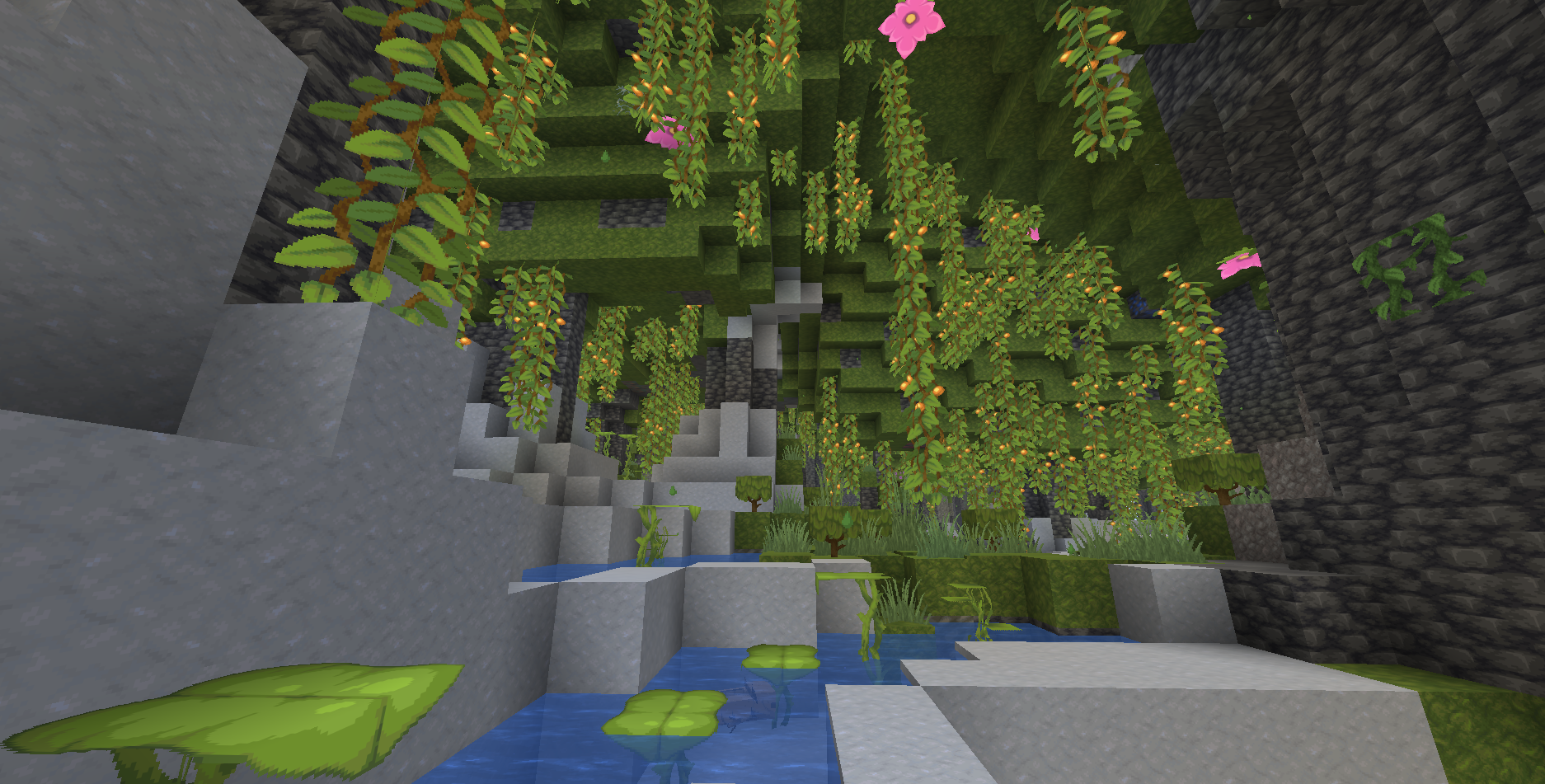
Most caves in Minecraft are dark, rocky places where you watch the ceiling for danger and the floor for lava. Lush Caves are different. These underground biomes are filled with moss, hanging vines, flowers, pools of water, and unusual plants. They bring a hidden garden beneath the Overworld—and add new places to explore, build, and gather resources.
When Were Lush Caves Added?
Lush Caves arrived as part of the two-part Caves & Cliffs Update. The blocks and plants associated with the biome were introduced in Java Edition 1.17 on June 8, 2021. The biome itself did not generate naturally in ordinary worlds yet. That changed with Java and Bedrock Edition 1.18 on November 30, 2021, when Minecraft received its redesigned cave and terrain generation.
This two-stage release meant players could encounter some Lush Cave blocks before they could explore naturally generated Lush Caves. Part II brought the underground biome to the Overworld along with deeper caves, new terrain, and expanded world-generation limits.
How to Find a Lush Cave
Lush Caves generate underground in the Overworld. One of the best clues is an azalea tree on the surface. Azaleas are associated with Lush Caves, so finding one is a strong sign that a lush biome may lie below. Explore carefully downward rather than digging straight beneath yourself; the cave may be deep, uneven, or intersected by other caverns.
Inside, look for moss-covered floors and ceilings, clay pools, dripleaf plants, and cave vines bearing glow berries. Lush Caves can contain open caverns as well as smaller, winding passages. They are often brighter and greener than ordinary caves, but they are still caves: hostile mobs can spawn in dark areas, and drops, ravines, and other hazards are still possible.
Plants, Blocks, and What They Do
The update added several blocks and plants that define the biome. Some are useful for building or farming; others are mainly decorative or create interesting movement challenges.
| Block or plant | What it does |
|---|---|
| Moss Block | A green ground-cover block. Bone meal can spread moss across nearby suitable blocks and produce moss carpet and small plants, making moss useful for decorating and landscaping. |
| Moss Carpet | A thin decorative covering made from moss. It lets builders bring the soft, overgrown look of a Lush Cave to other locations. |
| Azalea and Flowering Azalea | Decorative bushes found among the cave’s vegetation. Applying bone meal to an azalea can grow it into an azalea tree. |
| Azalea Leaves and Flowering Azalea Leaves | Leaf blocks used for decoration and tree growth. Bees treat flowering azalea blocks and flowering azalea leaves as flowers. |
| Rooted Dirt | A soil block associated with azalea trees and Lush Caves. Bone meal applied to rooted dirt can grow hanging roots beneath it. Using a hoe on rooted dirt turns it into regular dirt and drops hanging roots. |
| Hanging Roots | A delicate decorative plant that grows beneath rooted dirt. It adds detail to cave ceilings, gardens, and overgrown builds. |
| Spore Blossom | A large flower that attaches to the underside of a block and releases drifting particles. It is primarily decorative and gives a build a distinctive, hazy atmosphere. |
| Small Dripleaf | A small plant associated with the clay pools. It can be grown into big dripleaf with bone meal and can be used as a decorative plant. |
| Big Dripleaf | A broad leaf that tilts when an entity stands on it, eventually dropping anything on top. This makes it useful for parkour, traps, and playful paths. Redstone power can keep it from tilting under ordinary contact. |
| Cave Vines | Climbable vines that hang from cave ceilings. They can grow glow berries, and bone meal can encourage berry growth. |
| Glow Berries | Edible berries that provide light when growing on cave vines. They can also be planted to grow new cave vines and used to lure and breed foxes. |
| Clay | Older Minecraft material that appears in pools within Lush Caves. Clay can be gathered for building; clay balls can be smelted into bricks, and clay blocks can be used in colorful construction projects. |
Creatures in the Water
The water pools add life to the biome. Axolotls can spawn in Lush Caves in water above clay blocks. Tropical fish can also spawn in Lush Caves, including at heights where they would not normally appear in other waters. These creatures make the pools feel like part of a living underground ecosystem.
Not every pool is safe to linger beside. Lush Caves remain part of the Overworld cave network, so ordinary hostile cave mobs may appear in dark areas. Bring torches, food, a weapon, and enough tools to gather what you find.
Why Lush Caves Matter
Lush Caves changed caves from simple routes to ore into destinations with their own materials, wildlife, and atmosphere. Moss and azaleas support natural-looking builds; glow berries provide food and light; rooted dirt and hanging roots add texture; and dripleaf creates new movement possibilities. The biome also gave players a memorable way to discover the underground world: spot an azalea tree above ground, then follow the clue below.
Whether you are searching for axolotls, collecting glow berries, harvesting moss, or building an underground sanctuary, Lush Caves offer a greener side of Minecraft’s depths.